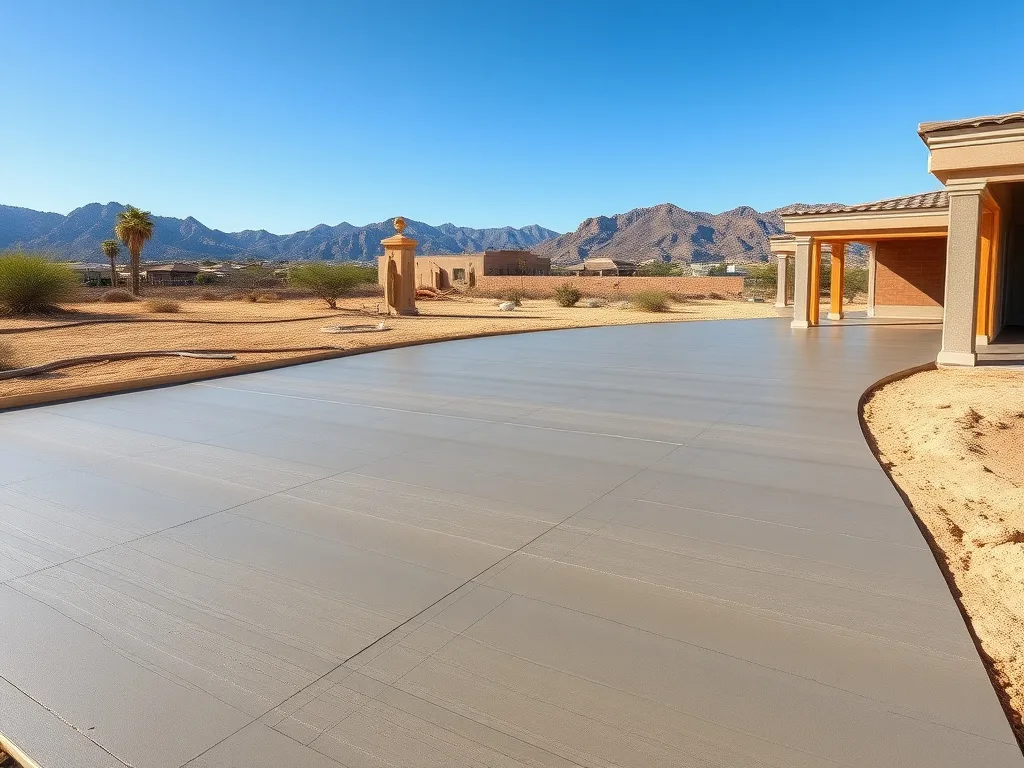
New Pours — Southern Arizona
New Concrete Pours — Driveways, Patios & Slabs Built for Southern Arizona Ground
A new slab is only as good as what's underneath it. We prep and compact the base to account for Tucson-area caliche and monsoon drainage before a truck ever shows up — so the driveway or patio you pour today isn't cracking in three summers.
New driveways, patios, walkways & slabs
New pours cover the full range of residential flatwork: driveways and garage aprons, patios and courtyards, walkways and sidewalks, RV pads, and utility or shop slabs. Whether it's replacing a failed section, extending an existing driveway, or pouring flatwork for new construction, the process starts the same way — with the ground, not the concrete.
Why base prep matters more here than almost anywhere
Southern Arizona's soil profile is genuinely different from a lot of the country, and it punishes shortcuts in base prep. The caliche hardpan common across the Tucson basin blocks water from draining straight down, so a slab poured without a properly graded and compacted base sits over ground that saturates unevenly every monsoon season and dries out unevenly every fall — the exact swell-shrink cycle that cracks concrete.
In the foothills — Catalina Foothills, areas around Vail near the Rincon foothills — the soil shifts to decomposed granite and sandier fill, which drains better but is prone to settlement if it isn't compacted to spec before the pour. Either soil type needs deliberate handling, and neither forgives a slab poured straight onto unprepared native ground.
- Excavation to consistent depth and removal of organic material
- Proper base course (typically compacted aggregate) graded for drainage
- Mechanical compaction verified before forming begins
- Grading that directs monsoon runoff away from the structure
Reinforcement and control joints built for the climate
We reinforce slabs with rebar or wire mesh sized to the application and cut control joints at spacing calculated for the region's heat-cycle range — Southern Arizona's summer surface temperature swings are aggressive enough that under-spaced or missing control joints are one of the most common causes of random cracking in new concrete here. A control joint that's correctly placed gives the concrete a planned place to crack invisibly instead of cracking wherever it wants.
For decorative new pours — stamped patterns, integral color, exposed aggregate — see our stamped and decorative concrete page for finish options that hold up to desert UV exposure.
Curing in Southern Arizona heat
New concrete loses moisture fast in this climate, and rapid moisture loss during cure is a direct cause of surface shrinkage cracking. We use curing compounds and, when conditions call for it, wet-curing methods to control the rate of moisture loss during the critical first days after the pour — especially on summer pours where surface temperatures can be extreme.
We also time pours around monsoon forecasts where possible; a fresh pour caught by an unexpected downpour before it's cured enough can be damaged, so scheduling around the season's storm patterns is part of the planning, not an afterthought.
What a new pour costs
New pour pricing depends heavily on square footage, thickness, reinforcement, base conditions, and finish — a plain broom-finished driveway costs meaningfully less per square foot than a stamped and colored patio. We provide fixed, itemized pricing after a site visit that accounts for your specific soil conditions, since base prep scope varies more here than concrete cost alone.
As a general industry reference, standard new flatwork commonly runs in a comparable range to full driveway replacement figures cited elsewhere on this site — every quote reflects your actual site conditions rather than a generic square-footage rate.
Get a new pour estimate
Tell us what you're pouring — driveway, patio, RV pad, shop slab — and your city, and we'll schedule a site visit to assess soil, drainage, and access before quoting. Serving Tucson, Sierra Vista, Marana, Sahuarita, and the surrounding region.
Call 844-967-5247 or use the estimate form to get started.
New Concrete Pours FAQs
Straight answers before we drill
Caliche hardpan common across the Tucson basin blocks water from draining downward, so a slab poured without properly graded, compacted base sits over soil that saturates and dries unevenly every monsoon cycle — a leading cause of cracking in poorly prepped new concrete here.
Typically about 7 days for light vehicle traffic and closer to 28 days for full structural strength, though this varies by mix design and weather. We'll give you a specific timeline based on your pour and current conditions.
Yes, but we plan around storm forecasts — a fresh pour caught by an unexpected downpour before it's sufficiently cured can be damaged. We schedule pours with the season's storm patterns in mind and can often work around a tight timeline.
Yes — new pours for new construction, additions, and full replacements of failed or outdated flatwork. If your existing slab just needs leveling or resurfacing rather than full replacement, we'll tell you that instead of selling you a new pour you don't need.
Sunken slab or cracked driveway? Get a real number this week.
Free estimates across Southern Arizona. Most residential jobs are quoted and scheduled within days, not weeks.