Polyurethane Lifting — Southern Arizona
Polyurethane Concrete Lifting — Fast, Lightweight Leveling for Southern Arizona Slabs
Expanding polyurethane foam weighs a fraction of traditional mudjacking slurry, injects through holes the size of a dime, and reaches working strength in about 15 minutes — ideal for pool decks, patios, and finishes you don't want to gamble on.
Why weight matters on already-weak soil
Here's the core logic: your slab sank because the soil underneath couldn't carry the load it had. Pumping a heavy cement slurry back onto that same soil — mudjacking runs well over 100 lb per cubic foot — asks a soil that already failed once to carry even more. It often works, but on Southern Arizona's monsoon-saturated caliche-and-clay ground, it isn't always the most durable long-term answer.
Polyurethane foam weighs around 2 lb per cubic foot — roughly 2% of slurry's weight — and does its lifting through expansion pressure rather than added mass. It fills voids, raises the slab, and doesn't reload the weak ground underneath it.
How the injection process works
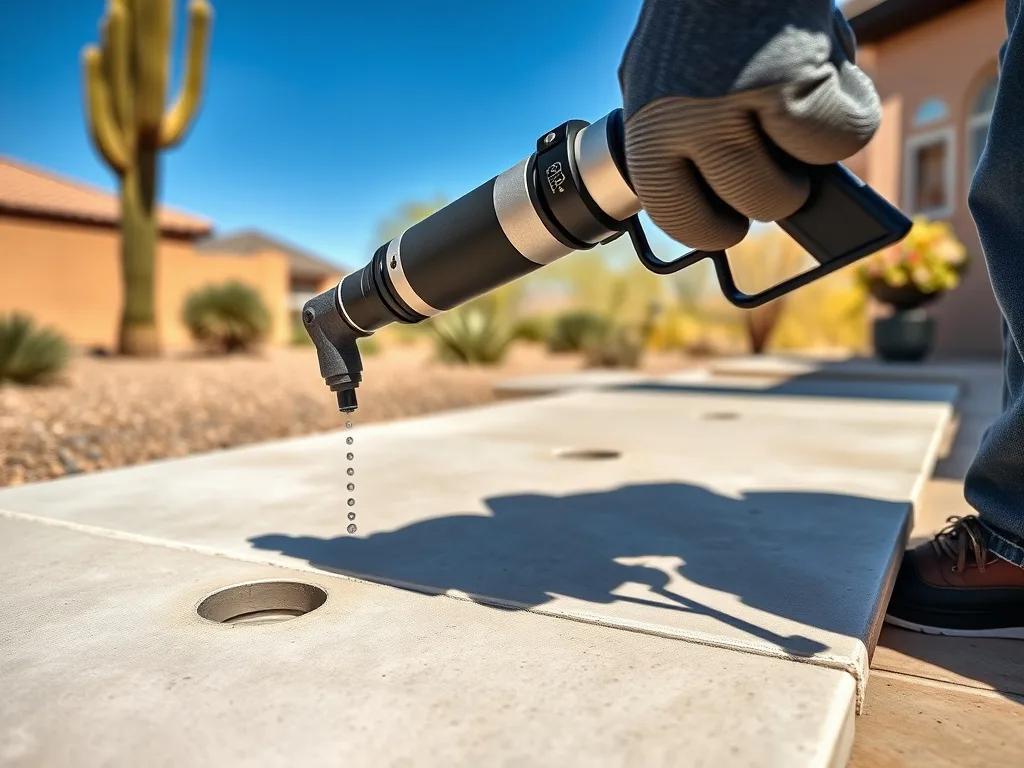
We map the settlement with a level, drill a pattern of 5/8-inch holes — about the size of a dime — and inject two-part polyurethane foam that expands and reaches roughly 90% of its strength within about 15 minutes. We lift in small, monitored increments, checking elevations continuously until the slab is back within a fraction of an inch of level.
The injection holes are patched with color-matched mortar, joints are caulked, and the slab is ready for full use almost immediately — a real advantage over the 24-to-72-hour cure window that mudjacking slurry requires.
Where foam is the clear choice
Pool decks are the classic case: they sit on backfill around the pool shell that's rarely compacted as well as native soil, and they carry decorative finishes — Kool Deck, acrylic coatings, stamped patterns, pavers — that a 1-to-2-inch mudjacking hole would visibly scar. Foam's small injection points patch nearly invisibly, and the slab can be back in barefoot service the same afternoon.
The same logic applies to stamped and decorative patios, travertine-over-concrete surfaces, and any slab where you're trying to preserve a finish rather than just level a utility surface. It's also the better call for lightweight structures and repeatedly wet ground — areas near irrigation lines, low spots that collect monsoon runoff, or foothills lots on decomposed granite fill that's still settling.
- Pool decks and coping — preserves Kool Deck, acrylic, and stamped finishes
- Stamped and decorative patios where patch visibility matters
- Slabs near irrigation lines or monsoon-saturated low spots
- Any repair where same-day return to service matters
- Foothills lots on decomposed granite fill still consolidating
What polyurethane lifting costs
As an industry-typical range, polyurethane injection runs roughly $8–$25 per square foot, generally higher than mudjacking's $4–$9 range because the material itself costs more to manufacture and inject. Most residential lifts still land well under the $2,000–$10,000+ cost of full slab replacement, and the foam's waterproof, closed-cell cure means it won't erode the way slurry can during a hard monsoon season.
The higher per-foot cost buys speed, cleanliness, and finish preservation — worth it on decorative and pool-adjacent work, less necessary on a plain utility driveway slab where mudjacking does the job for less.
How long a foam lift lasts
The cured foam itself is inert and waterproof — it doesn't rot, shrink, or dissolve, so the lift is effectively permanent from the material's side. What can still move is the ground, which is why every lift includes joint caulking and a look at what's feeding water toward the slab: irrigation drip lines, roof scuppers, or a drainage grade that's sending monsoon runoff the wrong direction.
We log injection points and volumes on every job. If the same slab needs a touch-up because the underlying soil kept moving, it's a small, quick visit — not a redo.
Get a polyurethane lifting estimate
Send photos of the slab and the affected area, or book a free on-site inspection anywhere from Tucson to Sierra Vista, Green Valley, and Nogales. We measure the settlement, sound for voids, and hand you a fixed price before any drilling starts.
Call 844-967-5247 or use the estimate form. If your slab is a plain utility driveway rather than a pool deck or decorative finish, ask whether traditional mudjacking might get the job done for less.
Polyurethane Concrete Lifting FAQs
Straight answers before we drill
As an industry-typical range, polyurethane injection runs roughly $8–$25 per square foot, higher than mudjacking's $4–$9 range but still generally well under the $2,000–$10,000+ cost of full slab replacement for a comparable area.
Almost immediately — the foam reaches roughly 90% of its strength in about 15 minutes, so you can walk on it right away and typically drive or swim the same day, versus 24–72 hours for mudjacking slurry to cure.
No — that's a main reason to choose foam over mudjacking on decorative surfaces. Injection points are 5/8-inch holes patched with color-matched mortar, versus the 1-to-2-inch holes mudjacking requires, which are far more visible on Kool Deck, acrylic, or stamped finishes.
Yes. Once it reacts — within seconds — the foam is inert, closed-cell, and doesn't leach into soil or water. The same chemistry is used to stabilize highways, airport aprons, and buried utility lines nationwide.
Sunken slab or cracked driveway? Get a real number this week.
Free estimates across Southern Arizona. Most residential jobs are quoted and scheduled within days, not weeks.