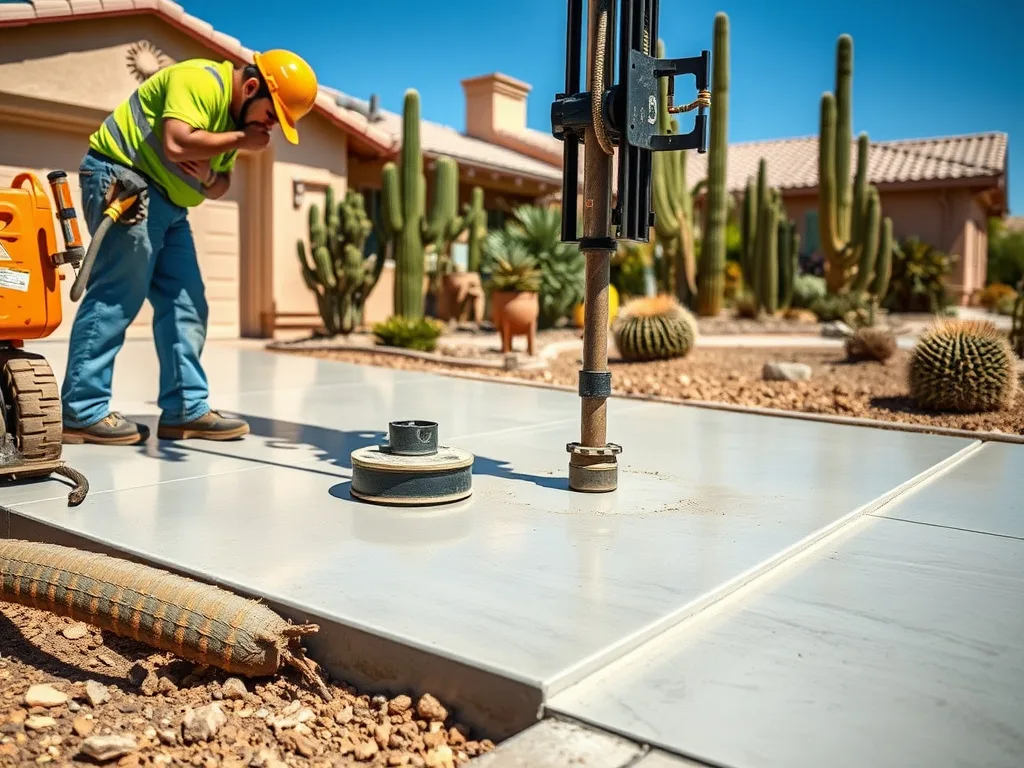
Slab Leveling — Southern Arizona
Slab Leveling & Mudjacking — Raise Sunken Concrete Across Southern Arizona
A dropped driveway panel or a patio that pools water after every storm usually doesn't need to be torn out. Mudjacking pumps a stabilizing slurry underneath and lifts the slab back toward grade at a fraction of replacement cost.
How to tell a slab is settling
Settlement rarely announces itself all at once. It shows up as a lip at a control joint that used to be flush, a driveway panel that catches your tire at the same spot every morning, or a patio corner that's started collecting water after monsoon storms instead of shedding it toward the yard.
Southern Arizona adds its own tell: cracking that opens up after a long dry stretch gets interrupted by a hard monsoon downpour. That's the caliche-and-clay cycle underneath — expansive soil pockets swelling against a cemented caliche layer, then drying and shrinking again, working the slab loose from below.
- A step or lip at a joint that used to be flush
- One driveway panel visibly lower than its neighbor
- Water pooling on a slab instead of draining away
- Cracks that widen after monsoon rain, following weeks of dry heat
- A hollow or drumming sound when you tap the slab edge
What's actually moving underneath
In the Tucson basin, most residential concrete sits over a layer of caliche — a natural, cement-hard calcium-carbonate deposit that typically starts 2 to 4 feet below grade. Caliche itself doesn't compress, but it does something almost as disruptive: it blocks water from draining downward, so monsoon runoff backs up and saturates the softer soil sitting on top of it, right where your slab's base course lives.
That soil is often a mix of silt and clay that expands when it's wet and shrinks again once it dries — a swell-shrink cycle that's mild in a normal year and dramatic after a wet monsoon season. In the foothills — Catalina Foothills, the Rincon-adjacent areas around Vail — the profile shifts to decomposed granite and sandier soils that behave differently: less swelling clay, more risk of loose, under-compacted fill settling under new construction.
Either way, the slab above didn't fail — the ground under it moved. That's why leveling, not replacement, is usually the right first call.
How mudjacking works
We drill a pattern of 1-to-2-inch holes through the settled slab, pump a cement-and-soil slurry underneath under controlled pressure, and lift the slab in small increments while checking levels the whole way. The slurry also fills the voids that formed as soil washed out or consolidated, giving the slab uniform support instead of resting on a partial void.
Mudjacking has been the standard concrete-leveling method for decades because it works, it's well understood, and it costs meaningfully less per square foot than polyurethane injection. For driveways, walkways, and utility slabs where a slightly heavier repair material isn't a concern, it's often the more economical choice.
What it costs and what to expect
As an industry-typical range, mudjacking runs roughly $4–$9 per square foot, with most residential single-slab jobs landing in the $500–$3,000 range depending on how far the slab dropped and how much void space the slurry has to fill. That compares to $2,000–$10,000+ for full removal and replacement of the same area — before accounting for the days of cure time and the new-concrete color mismatch that replacement leaves behind.
Cure time is the trade-off against polyurethane foam: mudjacking slurry typically needs 24–72 hours before the slab is back in full service, versus about 15 minutes for foam. For a driveway you don't need to use the same afternoon, that's rarely a dealbreaker.
When mudjacking is the right call — and when it isn't
Mudjacking is a strong fit for driveways, sidewalks, garage aprons, and utility slabs with moderate, even settlement and no severe cracking. It's a poor fit for slabs that are already broken into several pieces, decorative finishes where 1-to-2-inch patch holes would be visible, or pool decks and lightweight structures where the added slurry weight risks reloading soil that's already proven it can't carry the load — those situations usually call for polyurethane lifting instead.
We'll tell you honestly which method fits your slab during the free inspection, including when the ground itself — not the concrete — is the thing that needs addressing first.
Get a slab leveling estimate
Send a couple of photos of the settled area and your city, or book a free on-site inspection. We measure the actual drop, sound for voids, and give you a fixed price before any drilling starts — across Tucson, Sierra Vista, Green Valley, and the surrounding region.
Call 844-967-5247 or use the estimate form. If your slab is cracked into pieces rather than just settled, ask about our crack repair and foundation repair services too.
Slab Leveling & Mudjacking FAQs
Straight answers before we drill
As an industry-typical range, mudjacking runs about $4–$9 per square foot, with most single-slab residential jobs landing between $500 and $3,000 depending on settlement depth and void volume — a fraction of the $2,000–$10,000+ that full replacement often runs.
Typically 24–72 hours while the slurry cures. If you need the slab back in service the same day, polyurethane lifting cures to working strength in about 15 minutes and may be the better fit.
Caliche itself doesn't compress, but it blocks water from draining downward, so monsoon runoff saturates the softer clay and silt sitting above it — right where your slab's base course sits. That soil swells when wet and shrinks when dry, working the slab loose over repeated monsoon seasons.
Mudjacking slurry is a proven, decades-old method, though it's heavier than foam and can be more susceptible to re-settling if the soil underneath keeps moving. For driveways and utility slabs it's a reliable, budget-friendly repair; for pool decks or repeatedly-saturated ground, polyurethane's lighter weight is often the more durable long-term choice.
Sunken slab or cracked driveway? Get a real number this week.
Free estimates across Southern Arizona. Most residential jobs are quoted and scheduled within days, not weeks.